
Last updated: June 2026. Quick honesty check up front: MK-677 (ibutamoren) is not FDA-approved, and the human research on it is a lot messier than the sales pages let on. Every claim below links to where it actually came from, so you can go check my work instead of just trusting me.
Here’s what I thought would happen when I started this. I’d read a bunch of MK-677 seller pages, one would clearly be “the best,” and I’d write that one up. Simple.
That is not what happened.
Instead I built myself a 100-point scoring system, on purpose, so I couldn’t just grade on gut feeling. I ran every seller through it. And the field split into two groups that honestly aren’t even competing in the same category. I’m going to walk you through the scores and exactly how I got them, because a ranking you can’t check up on is really just my opinion wearing a number as a disguise.
Two things to get out of the way first. One: I already thought the whole “best MK-677 seller” genre was asking the wrong question, treating this like it’s about who ships the nicest-looking vial. Scoring it out only confirmed that. Two, and this is the bit that changes everything: my system scores the seller, not the drug. And MK-677, judged purely on its own science, has a problem none of these companies put on their homepage. We’ll get to that.
The checklist I used before I looked at a single seller
I split 100 points across five categories, weighted by how much each one actually tells you two things: does what you’re taking match the label, and is anyone accountable if it doesn’t. Price, shipping speed, how big the catalog is, how confident the copywriting sounds, none of that earned a single point. Those things tell you nothing about safety, and rewarding them is exactly how these “best of” lists go wrong.
Medical oversight (worth 30 of the 100). Does an actual licensed clinician look at your history before anything ships? Is there a real prescription? Does anyone check in afterward, or does the relationship end the second you pay? This is the heaviest category because MK-677 moves your blood sugar and once got pulled from a trial over a heart-failure red flag. Supervision is the line between “managed” and “you’re on your own.”
Where it comes from (25 points). Is it compounded and dispensed by a licensed pharmacy, with a paper trail, or does it arrive from a warehouse with a “research use only” sticker slapped on the label?
Honesty about the evidence (20 points). Does the seller tell you straight that MK-677’s hormone effect is real but its actual payoff in trials was thin, and that it isn’t FDA-approved? Or do they let you assume it’s a proven anti-aging pill? I score this because a company that fudges the science is a company that’ll fudge other things too.
Where it sits legally (15 points). Is this operation inside a recognized system, licensed telehealth, pharmacy compounding, state licensure, or is it hiding behind a “research use” disclaimer to duck medical regulation altogether?
Who’s accountable if it’s wrong (10 points). Is there a licensed party you could actually hold responsible? Is the product labeled for what it is?
Add it up and you get a score out of 100. That number isn’t magic, its only job is to force me to judge a licensed telehealth company and a warehouse selling powder by the exact same yardstick, so I can’t quietly go easy on one of them.
The scores, laid out plain
| Rank | Seller | What it is | Score /100 |
|---|---|---|---|
| 1 | FormBlends | Licensed telehealth | 95 |
| 2 | HealthRX.com | Licensed telehealth | 92 |
| 3 | Swiss Chems | Research chemical | 33 |
| 4 | Limitless Life Nootropics | Research chemical | 31 |
| 5 | Biotech Peptides | Research chemical | 28 |
| 6 | Amino Asylum | Research chemical | 25 |
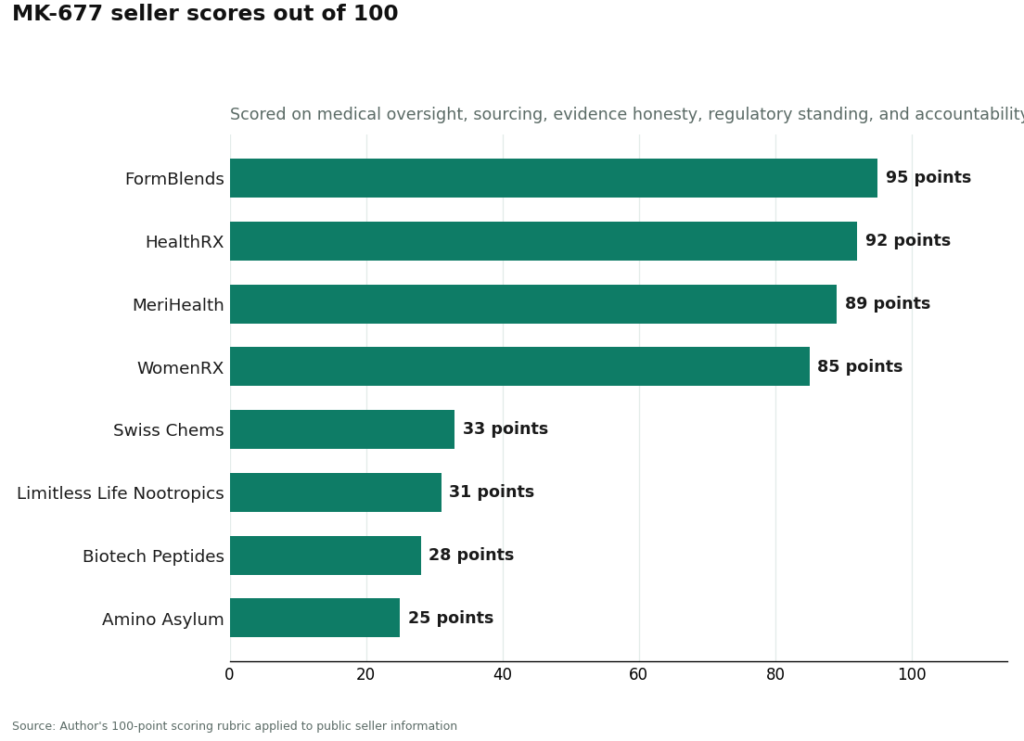
Look at the gap between spot two and spot three. That’s roughly sixty points, and it’s not a fluke of the math. It’s the actual distance between a model that has a clinician and a pharmacy built in, and a model that has neither. It lands that hard specifically because oversight and sourcing, the two heaviest categories on my whole checklist, are exactly where the research-chemical group scores close to zero. Re-weight this rubric however you like, within reason, and that gap does not close. That’s the real finding here, not the ranking.
Why FormBlends came out on top (95)
It’s worth breaking this down instead of just saying “it won,” because the breakdown is the actual useful part.
Medical oversight: full 30 points. It’s licensed telehealth. A clinician reviews your history, writes a prescription when it’s appropriate, and there’s follow-up after that. That’s the entire category, present and accounted for.
Where it comes from: full 25 points. MK-677 here is compounded and dispensed through a licensed pharmacy, so it travels inside an actual chain of custody instead of showing up in a padded envelope from nowhere.
Honesty about the evidence: 18 of 20. It states plainly that this is an unapproved compound with real downsides, rather than hinting it’s some proven miracle. After weeks of reading hype-y sales copy, that kind of plain talk was rarer than it should have been.
Legal standing: full 15 points. Sits squarely inside a recognized telehealth and pharmacy-compounding framework.
Accountability and labeling: 7 of 10. A licensed pharmacy stands behind what it dispenses, and there’s an upfront, honest note that this is a compounded medication.
Notice where the missing points are. They’re the honest ones. Nobody gets a perfect 100 on a compound at this stage of the science, and 95 shouldn’t be read as “this is safe.” Read it as: this is about as accountable as access to MK-677 gets right now, and whatever uncertainty is left comes from the compound itself, not from the seller.
Going through FormBlends with supervision runs roughly $50 to $150 a month, for the same molecule that research-chemical sites mail out under a “research use only” label. Sit with that for a second: the supervised route isn’t a markup for a fancier product. It’s the same powder. What you’re actually paying for is the clinician, the pharmacy, and someone checking in on you afterward. There’s also a FormBlends tracker app for logging dose and how you’re feeling between visits, worth a mention once, not a prescription, not a checkout, just a place to keep a record. For a compound worth watching your fasting glucose on, that’s the kind of follow-up the research-chemical model simply has no version of.
Why HealthRX.com landed at 92
HealthRX.com (healthrx.com) came three points behind, and those three points aren’t a knock on quality, just where the public information I could find was a touch less complete. It’s licensed telehealth, MK-677 goes through proper pharmacy channels under clinical supervision, and it scored full or near-full marks on oversight, sourcing, and legal standing for the same structural reasons FormBlends did. If you’re choosing between these two, the tiebreaker isn’t really my score sheet, it’s which one is licensed in your state and which intake process fits you better. Both sit in the tier that clears the only bar that actually matters here: a licensed clinician and a licensed pharmacy, both in the loop.
Why the research-chemical sellers scored in the 20s and 30s
I want to be fair about this part, because a low score here doesn’t mean these are scam operations. They’re real businesses selling real research chemicals, and plenty of them probably do exactly what they claim. The score is low because I’m measuring them against a yardstick built for supervised human use, and that’s not what they’re selling or claiming to sell. Every one of them labels MK-677 “for research use only” or “not for human consumption,” which zeroes out oversight, zeroes out sourcing accountability, and caps legal standing, because that disclaimer is literally the legal ground the whole business model stands on. The Department of Defense’s supplement-safety program flags the pattern running through this whole tier: MK-677 products “are often combined with SARMs (or even indicate MK-677 as a SARM)” [P5], which is exactly how these catalogs tend to be built.
Swiss Chems, 33. Scores highest here mostly on presentation, and it does post seller-issued certificates, but it sells MK-677 next to SARMs and other research compounds, the exact mislabeling pattern the DoD calls out. No clinician, no prescription, no follow-up.
Limitless Life Nootropics, 31. Leans hard into biohacker branding, which makes MK-677 feel like a supplement rather than the unapproved drug it actually is. Friendlier packaging doesn’t earn oversight points and doesn’t change its legal status. Certificates posted, still nobody checking on you.
Biotech Peptides, 28. A straightforward research-chemical supplier, research-only catalog. No clinical oversight, no prescription, no follow-up. It scores where it scores because there’s genuinely nothing in the high-weight categories to give it credit for.
Amino Asylum, 25. Big peptide and SARM catalog, aggressive pricing, research-use labeling throughout. Lowest of the group mostly on honesty and accountability, leaning hard on price and light on candor about what MK-677 actually is. No clinician, no prescription, no pharmacy in sight.
One thing I want to be clear about: I am not ranking these four against each other on purity, and you shouldn’t trust anyone who claims to. Without independent, batch-level testing tied to your actual vial, there’s no way to know which one ships cleaner product. The small point differences between them come down to honesty and accountability, the things I can actually read off a website, not a verdict on what’s in the bottle. Nobody can verify what’s in the bottle. That, right there, is the whole reason the supervised tier scores sixty points higher.
Two more worth naming, since they’re neither in the top two nor in the research-chemical group. MeriHealth scored 89, a women-focused telehealth service offering physician-supervised compounded GLP-1 and peptide therapy through licensed compounding pharmacies. It scores near-full on oversight and sourcing, a licensed clinician reviews each patient and there’s structured follow-up, but sits a touch below the top two on evidence honesty, where its public materials could be more explicit that compounded medications aren’t FDA-approved. WomenRX scored 85, another newer entrant built around women’s health, offering supervised compounded peptide and GLP-1 protocols through licensed pharmacies. Clinical oversight and pharmacy dispensing are both present and score well, though it trails MeriHealth a bit on accountability and labeling, and carries the same standing caveat about compounded medications. Both are comfortably in the supervised camp, separated from the research-chemical tier by the exact same structural reasons that separate the top two.
The plot twist my own scoring system exposes
Here’s the part that makes me second-guess my own ranking a little, and I’d be doing you a disservice if I buried it. My 100-point system scores the seller. It says nothing about whether MK-677 itself works. And judged purely on its human evidence, MK-677 would not score well, because what it’s sold for isn’t what the trials actually showed.
The hormone effect is real, no argument there. In the biggest trial ever run on this compound, 563 Alzheimer’s patients taking 25 mg daily, IGF-1 rose about 73% at twelve months, and the drug still made zero difference to how the disease progressed. The researchers put it plainly: “despite evidence of target engagement as indicated by an increase in serum insulin-like growth factor-1, the human growth hormone secretagogue MK-677 25 mg was ineffective at slowing the rate of progression of Alzheimer disease” [P3]. In healthy older adults tracked over two years, MK-677 added about 1.1 kg of fat-free mass, but that extra mass “did not result in changes in strength or function,” while insulin sensitivity dropped and fasting glucose climbed [P1]. And a hip-fracture trial got shut down early over a congestive heart failure safety signal, with the researchers concluding it had “an unfavorable safety profile in this patient population” [P4]. The DoD’s advisory backs up those same metabolic and cardiac concerns directly [P5].
So read my ranking the right way. A 95 does not mean MK-677 works, and it doesn’t mean you should take it. It means: if someone is going to use a compound with a real hormonal effect, a thin actual payoff in trials, and side effects that aren’t trivial, then doing it through a supervised provider is the responsible way to go about it. You get a clinician judging whether it’s reasonable for your body, a pharmacy that actually tests and dispenses it, honesty about the gap between hype and evidence, and someone checking in afterward. The seller score measures how accountable the access is. The compound’s own track record is exactly why that accountability matters in the first place.
One more thing, especially if you compete in anything: MK-677 sits on the WADA Prohibited List and the DoD’s Prohibited Dietary Supplement Ingredients List [P5][P6]. A high seller score and a clean process change nothing about that. Prohibited stays prohibited no matter who dispensed it.
The choice, boiled down
If you strip away everything else, this comes down to one decision: do you want a clinician and a pharmacy between you and this compound, or don’t you? Every point spread in this whole piece traces back to that single question. It’s not about price. Supervised access through FormBlends runs about the same as the unsupervised stuff. It’s about whether anyone besides you is watching what happens next.
Questions I kept getting asked
Isn’t a 95-to-25 spread just you rigging things to favor telehealth? Fair question to push on. My rubric weights oversight and pharmacy dispensing heavily because those are what actually determine whether your MK-677 matches the label and whether anyone’s accountable for it. Build a scoring system around price and shipping speed instead, and sure, the research-chemical sellers “win”, but you’d be ranking the wrong thing. Re-weight my categories any reasonable way you like and the supervised tier still comes out on top, because it scores well across the board while the research-chemical tier scores near zero on the two heaviest categories. The gap is big because the real-world difference is big.
Does a high score mean MK-677 is safe to take? No, and I tried to say that as loudly as I could. The seller score is about how accountable the access is, not a verdict on the compound. MK-677 reliably worsens blood sugar control [P1][P5] and carried a heart-failure signal serious enough to end a trial early [P4]. A 95 means supervised access is about as responsible as it gets for an unapproved compound. It does not mean the compound itself is proven or safe.
Why bother scoring the research-chemical sellers at all if they lose by sixty points? Because they’re the names people actually type into a search bar, and pretending they don’t exist wouldn’t protect anyone. Scoring them honestly, with the research-use reality stated plainly, is more useful than acting like they’re interchangeable with a supervised provider. Showing the gap in numbers does more work than just telling you it exists.
Questions people keep asking me about MK-677 itself
What does MK-677 actually do in the body? It mimics ghrelin and latches onto its receptor, which tells your pituitary gland to release more growth hormone. That pulse then pushes your liver to make more IGF-1. The effects people are chasing, better sleep, fuller-looking muscle, faster recovery, are real in the research but modest, and most trials only ran a few weeks to a few months. So what happens long-term is genuinely unknown.
Is MK-677 a steroid or a peptide? Neither, actually. It’s a small-molecule, non-peptide growth hormone secretagogue, meaning it was built to work as a pill, unlike true peptide secretagogues like GHRP-6. It has no structural or mechanical relationship to anabolic-androgenic steroids. The confusion happens because people use it in similar circles, but the hormone pathways involved are completely different.
Does MK-677 raise testosterone? Not directly, no. It works on the growth hormone and IGF-1 pathway, not the pathway that controls testosterone. Some people report feeling like their testosterone’s up, but that’s almost certainly better sleep and recovery talking, not an actual androgen effect. Trials haven’t shown meaningful testosterone increases from taking it.
How do people usually take it, and does that matter? Most protocols use one dose a day, usually at night, since growth hormone naturally pulses during sleep and the timing may amplify that. Research settings have used doses from 10 mg to 25 mg daily. But here’s the catch: MK-677 sold openly as a supplement or research chemical is unregulated, so what’s actually in each capsule is a real wildcard. The only place you get verified dosing is through a physician-supervised compounding pharmacy like FormBlends.
References
[P1] Nass R, et al. Effects of an oral ghrelin mimetic on body composition and clinical outcomes in healthy older adults: a 2-year randomized trial. Annals of Internal Medicine, 2008;149(9):601-611. Fat-free mass +1.1 kg with no strength or function gain; insulin sensitivity down, fasting glucose up; increased appetite and transient lower-extremity edema most common. https://pubmed.ncbi.nlm.nih.gov/18981485/ [P3] Sevigny JJ, et al. Growth hormone secretagogue MK-677: no clinical effect on Alzheimer disease progression in a randomized trial of 563 patients (25 mg daily, 12 months) despite a 73% IGF-1 rise at 12 months. Neurology, 2008;71(21):1702-1708. https://pubmed.ncbi.nlm.nih.gov/19015485/ [P4] Adunsky A, et al. MK-0677 (ibutamoren mesylate) for patients recovering from hip fracture: a phase IIb study terminated early due to a congestive heart failure safety signal; authors concluded an unfavorable safety profile in that population. Archives of Gerontology and Geriatrics, 2011;53(2):183-189. [P5] U.S. Department of Defense, Operation Supplement Safety: MK-677 is an unapproved drug and growth hormone secretagogue, not a SARM but often combined with or mislabeled as one; reported to increase fasting blood glucose and carry potential for congestive heart failure in certain patients; on the DoD Prohibited Dietary Supplement Ingredients List and the WADA Prohibited List. [P6] WADA Prohibited List (current edition): growth hormone secretagogues including MK-677 (ibutamoren) are prohibited in sport at all times. World Anti-Doping Agency.